%20{%20.cls-1%20{%20fill:%20%23fff;%20}%20}%20%3c/style%3e%3c/defs%3e%3cg%20id='Layer_1-1'%20data-name='Layer%201'%3e%3cg%20id='Layer_1-1'%20data-name='Layer%201-1'%3e%3cpath%20class='cls-1'%20d='m220.77,35.74c2.97,0,3.62,1.09,3.41,3.84-1.09,18.77-14.64,37.69-32.18,43.57-5.87,1.96-12.32,2.83-18.48,3.12-12.61.43-25.23.14-37.84.14-1.59,0-3.19.07-4.71.29-6.09.94-10.22,5.65-10.08,11.53.14,5.87,4.78,10.8,10.87,11.09,5.94.29,11.96-.07,17.9.22,13.77.72,23.78,7.54,29,20.59,8.12,20.22-6.6,42.7-27.98,43.06-11.24.14-22.54.07-33.78.07-8.41,0-10.73,1.88-12.69,10.15-.94,3.77-1.74,7.61-3.04,11.31-6.02,17.11-17.9,27.18-35.59,29.07-9.64,1.01-19.5.14-29.79.14,2.25-10,4.35-19.5,6.52-29,1.88-8.19,3.84-16.31,5.58-24.5,3.26-15.01,13.48-23.7,28.49-23.85,13.77-.14,27.47-.07,41.25-.22,5.44-.07,9.64-3.19,11.09-7.97,1.38-4.35-.07-9.79-3.99-12.25-2.1-1.3-4.78-1.96-7.25-2.32-7.83-1.09-15.87-.94-23.41-2.97-19.21-5-31.53-22.54-30.95-42.48.58-19.93,14.35-37.11,33.27-41.46,3.26-.72,6.67-1.09,10-1.09l114.39-.07h0Z'/%3e%3c/g%3e%3c/g%3e%3c/svg%3e)
· Fabian Schreuder · Data Science Projects · 4 min read
From Food Labels to Reusable Ingredient Data
How our team built a traceable reference corpus and tested a human-in-the-loop workflow for linking Dutch food ingredients to FoodOn and ChEBI.
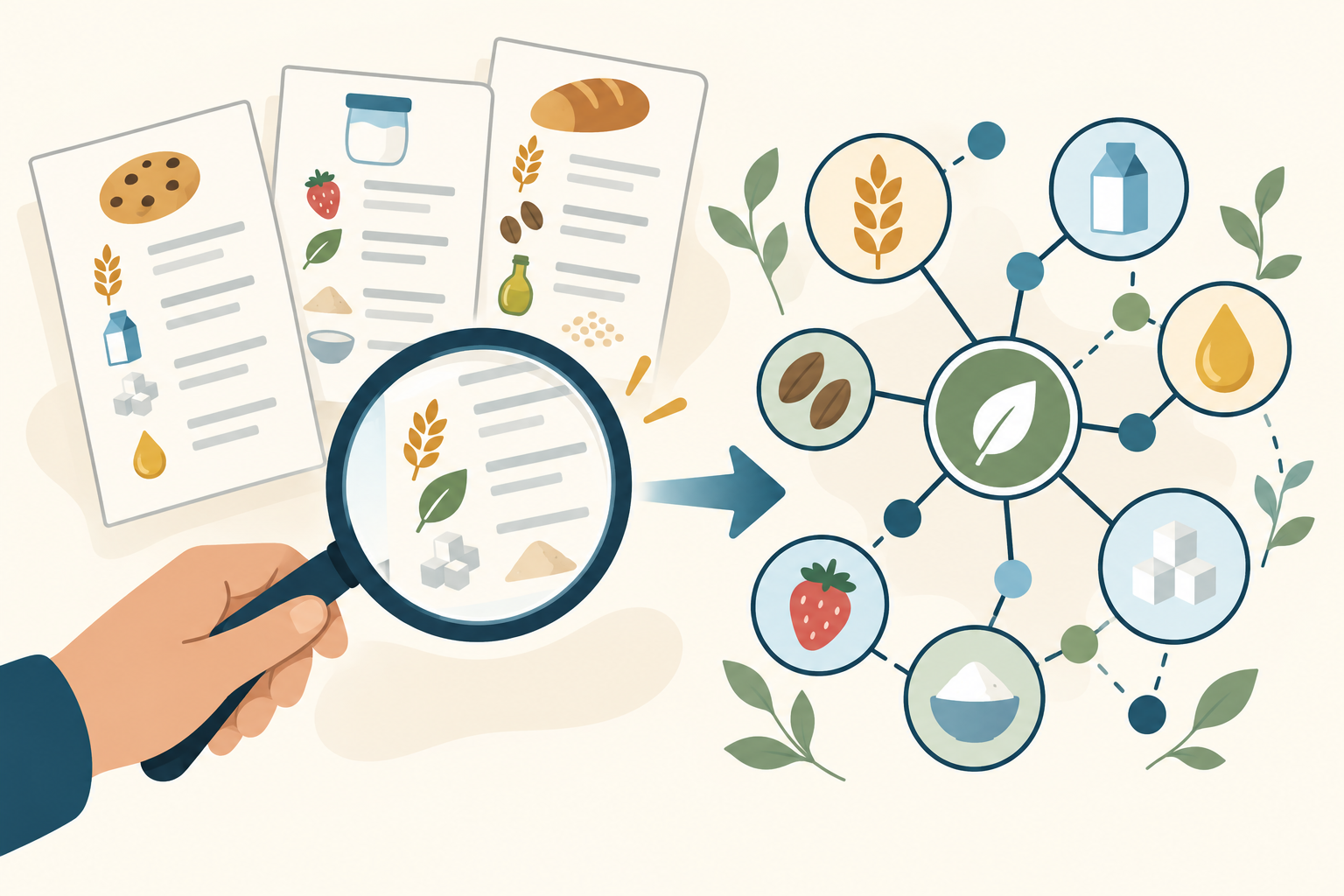
Food and nutrition research often combines data about products, nutrients, consumption, contaminants, and sustainability. To join those datasets reliably, they need to refer to the same ingredient in the same way. Product labels make that harder than it sounds: ingredient names vary, compounds contain sub-ingredients, E-numbers stand in for additive names, and processing details can change what a label means.
For the Auto-NICE project at RIVM, our team built a reference dataset and tested an automated workflow for linking Dutch ingredient declarations to shared concepts. FoodOn provides identifiers for food materials, while ChEBI is used for chemical substances. The goal was to make these decisions consistent and traceable, and to learn where automation helps and where a curator still needs to step in.
Building a Reference People Can Review
Working with Jens Ruhof and Tadeusz Price, I helped create a reference corpus of 192 product–ingredient occurrences from 81 meat and fish alternative products. An occurrence is a particular ingredient in a particular product, so repeated ingredients keep their product context. The corpus preserves the original label, its normalized form, compound context, annotator decisions, expert adjudication, and provenance.
We classified the entries into six groups: compound sub-ingredients, food additives, fortificants, commodity ingredients, industrially modified ingredients, and flavouring substances. These groups capture different linking challenges, from familiar ingredients such as flour to more specialized ingredients such as isolates and flavourings. Difficult food-domain decisions were reviewed by a nutrition expert, and the original votes were retained so later users can see how each reference decision was reached.
From a Dutch Label to a Candidate Concept
The workflow treats ingredient interpretation and ontology linking as a sequence of reviewable steps:
- Standardize the label. The workflow cleans ingredient text while keeping the parent compound and product context, which help define what each ingredient occurrence means.
- Resolve stable terms directly. E-numbers and expert-curated mappings use deterministic lookups where possible.
- Search for concepts. For other ingredients, Qwen3 embeddings and a FAISS index retrieve candidate FoodOn concepts from the standardized query.
- Select or abstain. A language model reviews the candidate labels, definitions, and ontology context, then chooses an option or makes no choice. It cannot recover a correct concept that was missing from the candidate list.
Keeping search separate from selection is useful for understanding errors. If the right identifier never appears among the options, asking a second model to reconsider the same list will not solve the problem. The workflow also retains the evidence behind each decision so a curator can review, correct, or reject a proposed mapping.
What the Evaluation Showed
The full automated test used saved system outputs for 159 non-E-number occurrences. A comparison with at least one original annotator choice was possible for 144. Search included an identifier chosen by an annotator for 100 of those 144 rows (69.4%). When search had included a human choice, the final system choice agreed with an original annotator in 65 of 100 cases (65.0%). These are agreement measures, not independently verified accuracy scores: annotators sometimes disagreed, and some decisions were later adjudicated.
The system proposed an identifier for 114 of the 159 rows (71.7%). That measures how often it returned an answer, not whether the answer was correct. On the 93-case benchmark of deliberately difficult, expert-resolved examples—79 of which also appear in the full test—28 mappings (30.1%) exactly matched the reference. In 43 of the 65 errors, the correct identifier was missing from the search results; in the other 22, it was available but the system selected another option.
The difficult cases also show why an automated warning should not be treated as proof that FoodOn is missing a concept. Expert review found an acceptable standardized concept for 54 cases, classified 31 as search gaps and six as granularity mismatches, and identified one class-versus-attribute issue and one likely ontology gap. The broader automated test flagged 34 possible gaps; those flags are a review queue, not confirmed ontology deficiencies. Many apparent ontology problems can begin earlier, with how a label is normalized or which candidates are retrieved.
A Curation Assistant, Not an Automatic Mapping Service
The strongest contribution of Auto-NICE is a reusable reference corpus, explicit annotation rules, and a benchmark that makes future changes easier to assess. The prototype can prepare candidate mappings and highlight cases for review, but its results do not support unattended acceptance. Ingredient standardization and candidate search are the first areas to improve; the report recommends measuring those stages directly before investing in another reasoning model.
The current work addresses ingredient identity. It does not estimate ingredient quantities or population exposure, and its products were selected to develop rules for complex labels rather than to represent every food category. Those remain important next steps. For now, Auto-NICE provides a traceable way to turn inconsistent label text into structured decisions that food-data curators can examine and improve.